Lockpicking 101 - The Basics of Pin Tumbler Locks
Lockpicking is a mix of hands-on skill and a bit of technique — and it’s been grabbing the attention of locksmiths, security folks, and curious hobbyists for ages. Understanding how locks work is fundamental to appreciating security systems and can be a valuable skill for security professionals, and is similar in its approach as cybersecurity. This article will introduce you to the basics of lockpicking, focusing specifically on pin tumbler locks, which are the most common type of lock found in residential and commercial settings but also in CTFs !
What is a Pin Tumbler Lock?
A pin tumbler lock is a type of lock mechanism that uses pins of varying lengths to prevent the lock from opening without the correct key. GPT told me that it was invented by Linus Yale Jr. in the 1860s, but I don’t really care tbh. It’s the most common type of locking mechanism and the one most people will think about when talking about padlock and door locks.

Standard view of a pin-tumbler lock
Anatomy of a Pin Tumbler Lock
Before we dive into picking techniques, it’s essential to understand the components of a pin tumbler lock:
Key Components
- Cylinder (also called “plug”): The rotating part of the lock that turns when the correct key is inserted
- Housing (Shell): The outer cylinder that contains the cylinder
- Key Pins: The bottom pins that make contact with the key
- Driver Pins: The top pins that are pushed down by springs
- Shear Line: The gap between the plug and housing where pins must align
- Springs: Small springs that push the driver pins down
- Keyway: The slot where the key is inserted
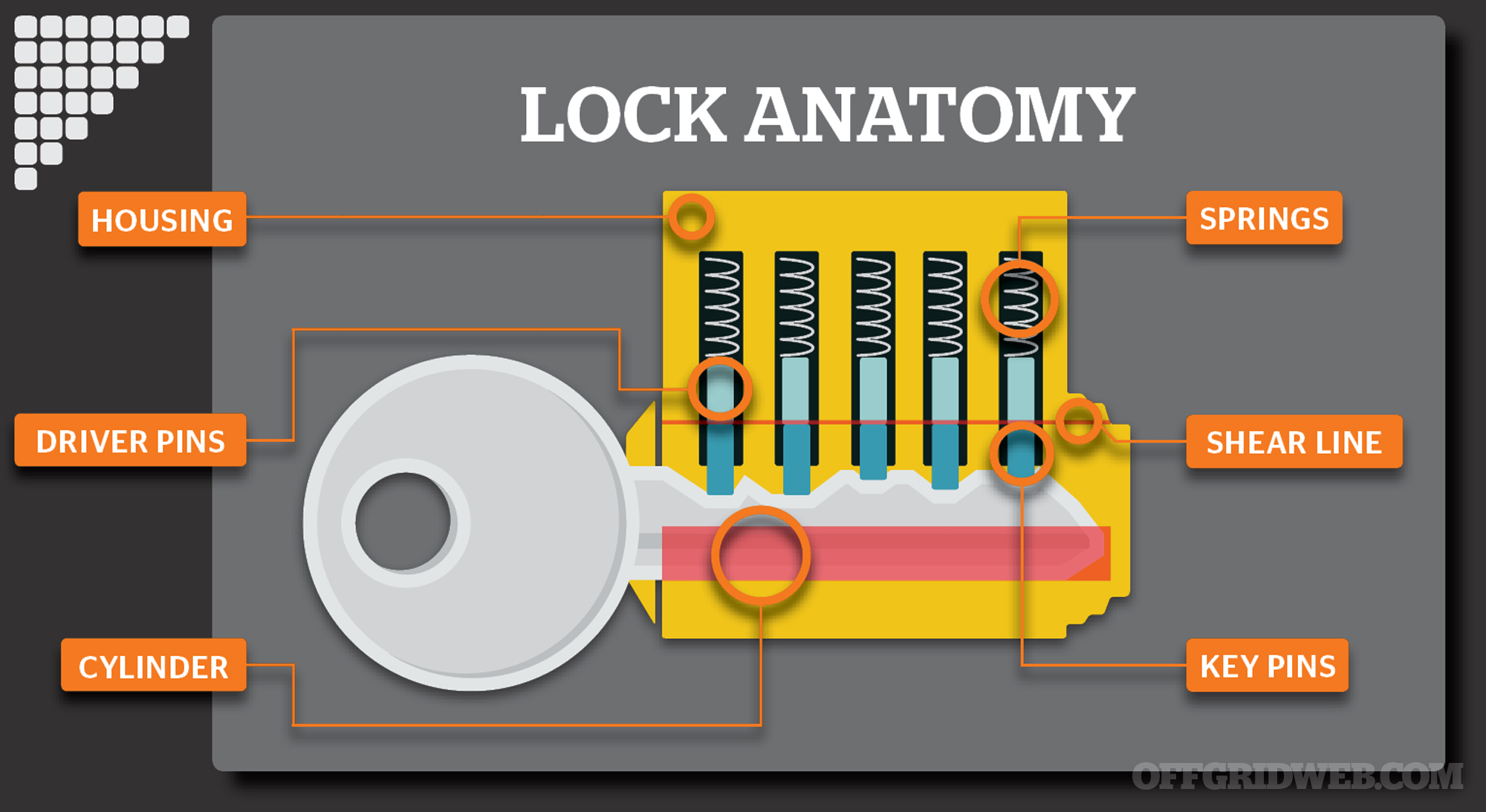
Cross-section view of a pin tumbler lock showing all components, credits: https://www.offgridweb.com
How Pin Tumbler Locks Work
With the Correct Key
When the correct key is inserted:
- The key’s cuts align all the key pins to the exact height needed
- The driver pins are pushed up, clearing the shear line
- The plug can rotate freely, allowing the lock to open
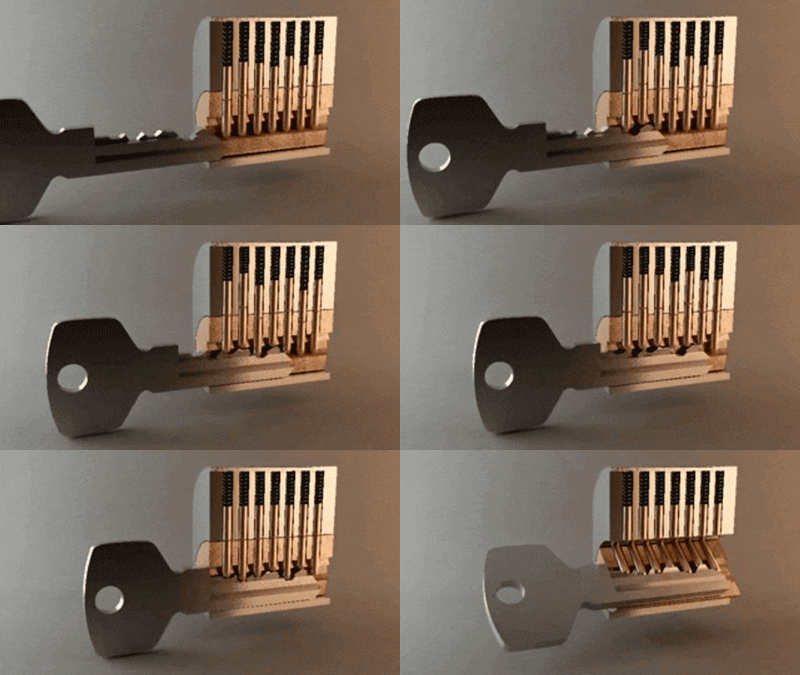
Animation showing how a correct key aligns pins at the shear line
Without the Correct Key (Locked State)
When the lock is locked without a key or with the wrong key:
- The pins are misaligned
- Driver pins cross the shear line, preventing the plug from rotating
- The lock remains secure

Visualization of pins blocking the shear line
Essential Lockpicking Tools
To pick a pin tumbler lock, you’ll need two basic tools:
1. Tension Wrench/Tension Tool
The tension wrench applies rotational pressure to the plug, creating a binding condition that allows you to set pins one at a time.
There are multiple types of tension tools, but they all work the same. The important thing to keep in mind when choosing it is that it need to allow you to apply steady torque on the cylinder while letting you some room in the keyway to maneuver.
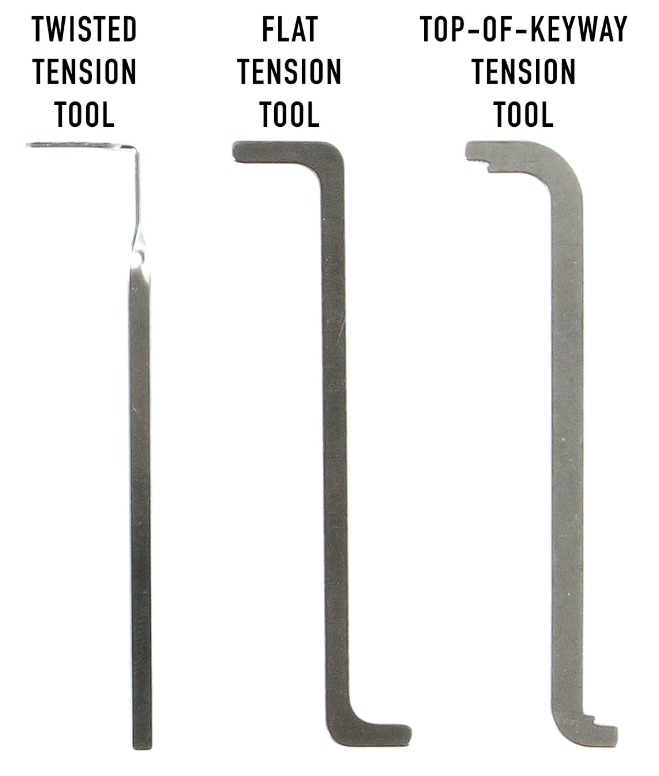
Various types of tension wrenches
2. Pick
The pick is used to manipulate individual pins to their correct positions.
Common Pick Types:
- Hook Pick: Most versatile, used for single pin picking
- Rake Picks: Used for “bruteforcing” picking, we’ll cover that later
- Half-Diamond: Versatile for both raking and single pin picking and some other approach we’ll cover in another article
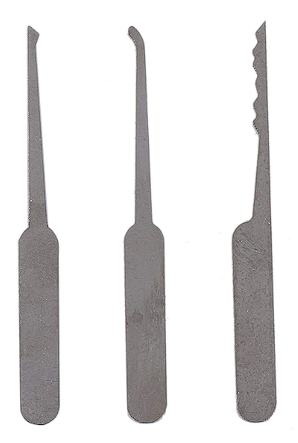
A selection of (poor quality but illustratives) common lock picks
Basic Lockpicking Techniques
Single Pin Picking (SPP)
Single pin picking is the most precise and educational method. It involves setting each pin individually to the correct height.
Process:
- Insert the tension wrench into the keyway
- Apply light tension in the direction the key would turn (a friend of mine like to compare the force you need to apply on the tension tool as the one you’d apply to a light switch)
- Use your pick to lift each pin one at a time
- Feel for pins that are “binding” (harder to move)
- There will be only 1 pin binding at a time, and it can be any of the unset pins !
- Lift binding pins until you feel a slight click (the pin setting at the shear line), it might occure alongside a slight movement of the core
- Continue until all pins are set and the plug rotates

Animation demonstrating single pin picking technique
Key Concepts:
- Binding Order: Pins don’t all bind at once; they bind in a specific sequence
- Feedback: Learn to feel when a pin sets (slight click or movement)
- Oversetting: Lifting a pin too high, which prevents the lock from opening, if that happens, the only option is to let go a bit of tension, in the hope of letting only the overset ping falling back to position, oooor to start back to the beginning
Raking
Raking is a faster but less precise technique that involves rapidly moving a rake pick across the pins. It works a bit like bruteforcing a password: the waves on the rake will try many positions for each pin, in the hope of finding the correct combination
Process:
- Insert tension wrench and apply light tension
- Insert rake pick and rapidly move it in and out, up and down
- Vary the pressure and angle
- The goal is to set multiple pins simultaneously through the rapid motion
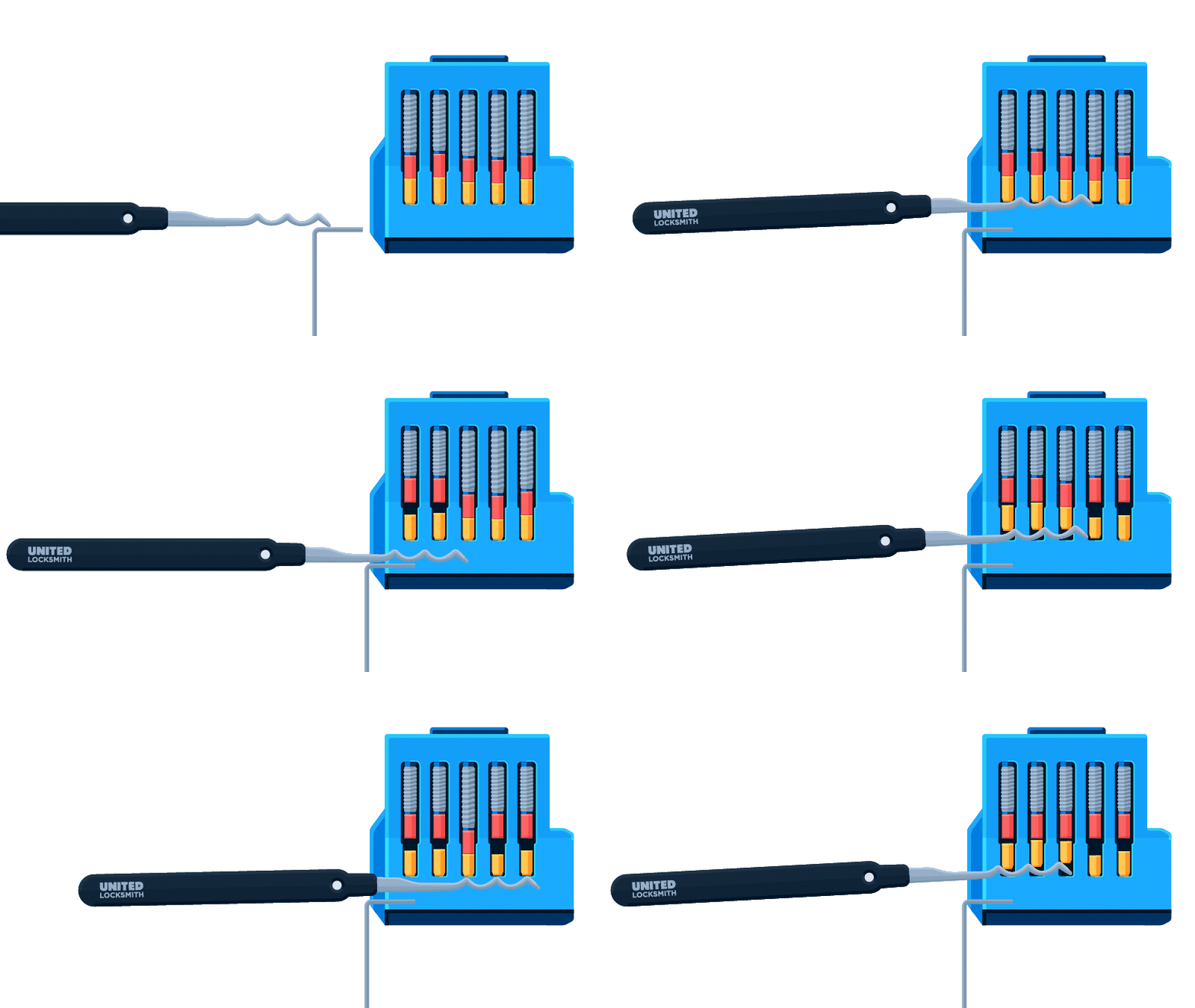
Demonstration of raking technique
Pros:
- EZ
- You can get an open really quickly
- Works on many low-security locks (And even a few CTF locks !)
- You can use that to quickstart the picking process, by setting a few pins with raking and then switching back to sigle pick picking
Cons:
- Only works on low security locks
- A single security pins will usually prevent this method to work
- If you use too much tension or force on the rake, the risk of getting a pin to an overset position is high :/
- If that’s the only method you know about, you’ll 100% look like a monkey in CTFs 🦧
Step-by-Step: Picking Your First Lock
Preparation
- Choose a practice lock: Start with a clear acrylic or cutaway lock to see what’s happening inside, there are a tons on amazon or any chinese websites. Be careful though, as these locks are often so poorly made that the feedback might not be the same as “real” locks
- Gather your tools: Tension wrench and hook pick, again there are cheap sets that you can buy online, most of them are good enough, don’t feel the need to buy expensive stuff, there is really not that big of a difference
- Find a comfortable position: Good lighting and a stable surface, for practicing, a vice is the go-to !
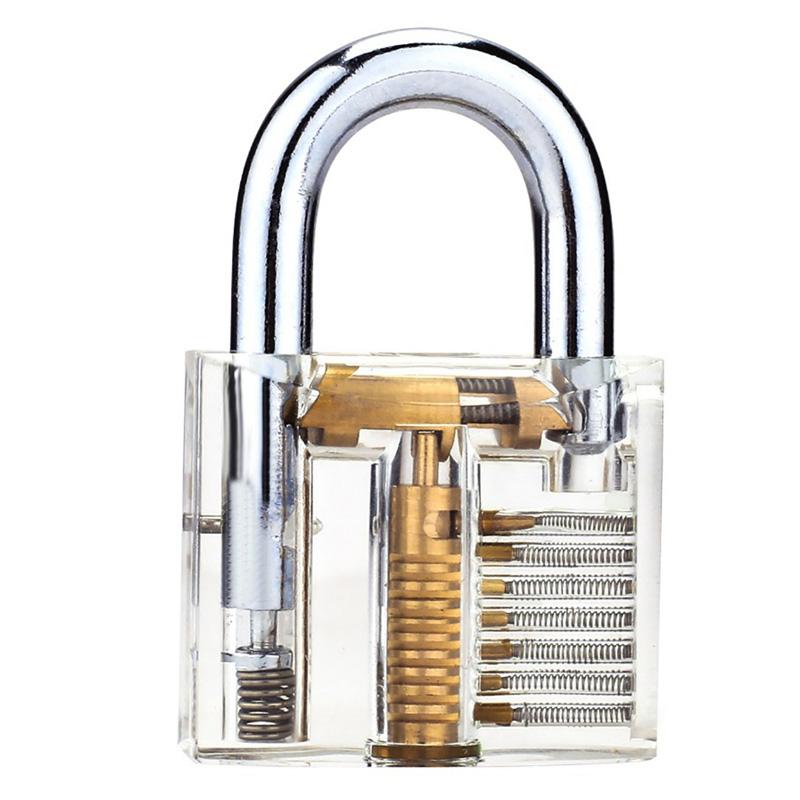
Crappy acrylic padlock showing internal mechanism
Understanding Binding and Feedback
What is Binding?
Binding occurs when a pin is caught between the plug and the housing at the shear line. When you apply tension, one pin will bind first because of manufacturing tolerances and the angle of rotation.
To make it simple: only one pin is preventing the core from turning at any given time. When applying tension, this pin will get caught between the core and the chamber and this is that interaction that makes the pin “resists” (binding) when pushing it. When reaching the shear line, the pin won’t prevent the core from turning, it is now set ! You can now go to the next pin.
Reading Feedback
Learning to read feedback is crucial for successful lockpicking:
- Click: A pin has set at the shear line
- Springy: Pin is not binding, still has spring tension
- Resisting: Pin is binding but not yet set
- Mushy: Pin may be overset
- No movement: Pin is fully set or (really) overset, you might also be applying too much tension
- No movement but a sliiiiight springiness: pin is probably set
Geez it’s really hard to describe finger feelings by text, you’ll probably have to understand what I mean by trying it yourself, sorry !
Common Mistakes and How to Avoid Them
1. Too Much Tension
Problem: Applying excessive rotational force Result: Pins bind too tightly, making them impossible to set Solution: Use the lighter tension you goblin ! Just enough to create binding
2. Oversetting Pins
Problem: Lifting pins too high Result: Driver pin goes below the shear line, blocking rotation Solution: Lift pins just until you feel the click, then stop
3. Inconsistent Tension
Problem: Varying tension while picking Result: Pins that were set become unset Solution: Maintain steady, light tension throughout the picking
4. Tool issues
Problem: Not having a deep enough hook Result: You can’t set a pin deeply enough without oversetting a pin sitting in front of it Solution: Use a deeper hook for that specific pins, yep sometimes you’re not the issue, you’re just facing a better lock
Practice Tips
- Start with clear locks: Visual feedback helps understand the mechanics
- Practice, practice, practice: Muscle memory and feel develop over time
- Try different locks: Each lock has unique characteristics
- Join a community: Lockpicking communities offer great resources and support like r/lockpicking and Lockpickers United (their discord)
Legal and Ethical Considerations
Obviously I need to give you some guidlines…
⚠️ Important: Lockpicking should only be practiced on locks you own or have explicit permission to pick.
I also do not recommand practicing on lock you or someone relies on, you don’t want to break your door lock, either in open or closed position…
Also don’t hesitate to check out your country’s laws about owning lockpicking tools, I know that there are no problems in France, but they are strictly prohibited in Japan.
Ethical Practice
- Always practice on locks you own
- Never pick locks in use without permission
- Use your skills responsibly and legally
Advanced Concepts
Once you’ve mastered the basics, you can explore:
- Security Pins: Spool pins, serrated pins, and mushroom pins that make picking more difficult
- Different Lock Types: Wafer locks, disc detainer locks, dimple locks
- Bypass Techniques: Shimming, impressioning, decoding
- Lock Analysis: Understanding lock security ratings and vulnerabilities
Will probably do articles about these, but for the moment google is your friend ^^
Conclusion
Lockpicking is a fascinating skill that combines mechanical understanding, tactile sensitivity, and patience. By starting with pin tumbler locks and mastering the fundamentals, you’ll build a solid foundation for more advanced techniques. Remember to practice legally, ethically, and responsibly.
The key to success is consistent practice, attention to feedback, and understanding the mechanical principles at work. Start with simple locks, develop your feel for the tools, and gradually work your way up to more challenging locks.
Happy picking! 🔓
That feeling when you finally get the lock you struggled on to open mmmmhhhhh
A slide that sums up this article :
Note: This article is for educational purposes only. Always ensure you have legal permission before picking any lock.