Dimple Locks 101 - Side Pins, Flag Picks and Why They Look Scarier Than They Are
Dimple locks have a reputation. They look different, the keys look fancy, the tools look weird, and the marketing often says things like “high security” with a very serious font.
The good news: a basic dimple lock is still mostly a pin tumbler lock.
The bad news: it is a pin tumbler lock that has been rotated, stretched, multiplied, filled with security pins, and placed behind a keyway that makes your normal hook pick feel like a spoon in a keyhole.
So yes, dimple locks are different. But they are not alien technology. If you understand the basics of pin tumbler locks and security pins, you already understand a large part of the game.
What Is a Dimple Lock?
A dimple lock is a pin tumbler lock where the key is usually flat, and the cuts are drilled as small dimples into the face of the key instead of being cut along the edge.
On a classic pin tumbler key, the bitting is on the blade edge. Pins move vertically into those cuts. On a dimple key, the bitting is on the flat side of the key, so pins often approach from the side, the top, or multiple angles around the keyway.
A typical dimple cylinder and matching key.
The important idea:
A dimple lock is not hard because “dimple” is magic. It is hard because of access, pin count, security pins, tolerances, and feedback.
Dimple vs Classic Pin Tumbler
The core principle stays familiar:
- Pins block the plug from rotating
- The correct key lifts each pin pair to the shear line
- Once every blocking element clears, the plug turns
The differences are practical:
- The pins may be arranged on one side, both sides, the top, or several rows
- The keyway is usually wide and flat
- Pin travel can feel shorter
- Feedback often feels more subtle
- Many dimple locks include security pins
- Some models have a lot of pins
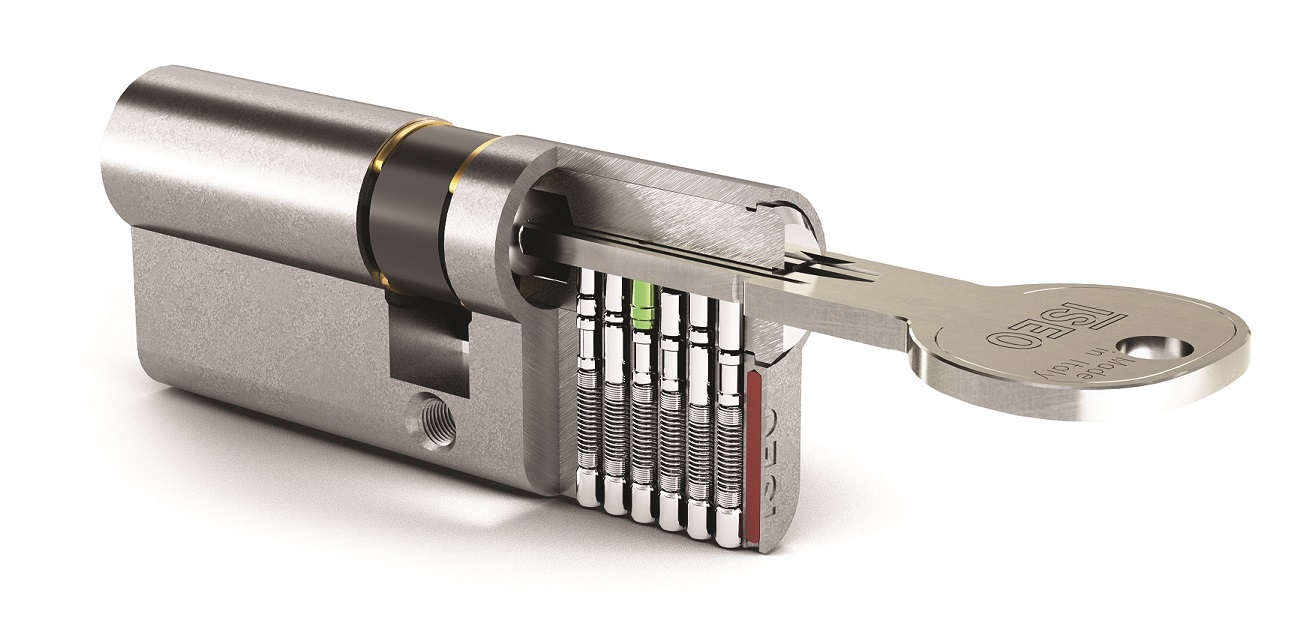
Dimple cores can include many pins and many security features.
A cheap five-pin dimple lock can be easy. A well-made multi-row dimple cylinder with security pins can be very annoying. The word “dimple” alone does not tell you the difficulty.
Why Dimple Locks Feel Intimidating
The first difficulty is orientation.
With a standard pin tumbler lock, you usually lift pins upward. Your hook goes under a pin, you push up, and your brain accepts the geometry pretty quickly.
With dimple locks, you may need to push pins sideways, upward, diagonally, or from different rows. The pins are not always in the place your hand expects them to be. The pick may need to rotate rather than lift.
The second difficulty is space.
Dimple keyways can look roomy, but the usable working angles are specific. You need enough room for tension and enough room to rotate the pick flag without scraping everything.
The third difficulty is feedback.
Because the lifting motion is rotational and the pin travel can be short, feedback may feel muted at first. You still get binding, clicks, counter-rotation, and oversets, but they arrive through a different hand motion.
The Dimple Tension Tool: Z-Bar
Normal tension tools can work sometimes, but dimple locks usually feel better with a dedicated tool. The classic option is a Z-bar.

Z-bars give stable tension while leaving room for a flag pick.
A Z-bar is useful because dimple keyways are wide and flat. It lets you apply controlled torque while leaving the central part of the keyway available for the pick.
Good tension still matters more than tool branding. A fancy dimple tensioner used badly is still bad tension.
When choosing a tension position, ask:
- Does it bind cleanly?
- Does it leave room for the flag?
- Can I feel plug movement?
- Can I reduce tension without losing all control?
If the answer is no, try another placement.
The Dimple Pick: Flag Picks
The dedicated dimple pick is called a flag. Instead of a normal hook tip, it has a small blade or flag at the end of a shaft.
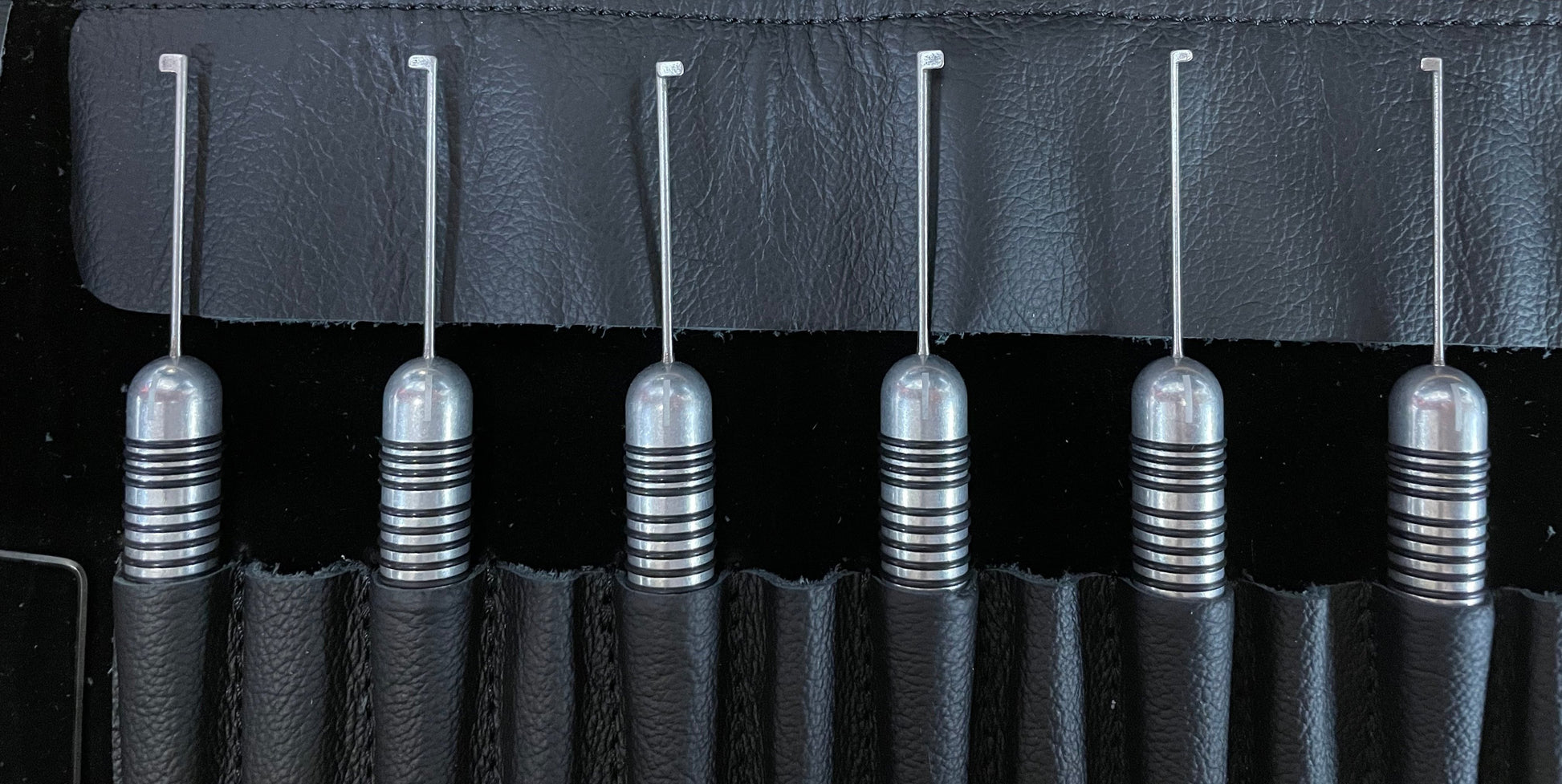
Flag picks come in different shapes and orientations for different rows and keyways.
You use a flag differently from a standard hook:
- Insert the shaft into the keyway
- Position the flag under or beside the target pin
- Rotate the pick to lift or push the pin
- Use small movements to test feedback
It feels strange at first because the pick is more like a tiny lever or steering wheel than a hook. You are not only moving up and down. You are steering, rotating, and controlling angle.
Left Flags, Right Flags and Orientation
Flag picks often come in left and right orientations. This is not just a naming detail. It affects which side of the keyway you can attack comfortably.
In a simple way:
- A right flag is often better for pins on one side
- A left flag is often better for pins on the opposite side
- A curved flag may help reach around warding
- A deeper or taller flag may help with awkward pin positions
You do not need twenty flags to begin, but you do need at least one that can reach the pins without fighting the keyway the whole time.
If you cannot lift a pin without scraping three other things, the problem may be tool choice, not skill.
Tension Opposite Your Picking Direction
A common dimple tip is:
Tension in the opposite direction from your flag rotation.
For example, if your flag rotates counter-clockwise to lift pins, clockwise tension may give better leverage and clearer feedback. If your flag rotates clockwise, the opposite tension direction may feel better.
This is not a law of physics that overrides every lock. It is a practical starting point.
Why it helps:
- The flag has better leverage against the binding pin
- The pick is less likely to slip away from the pin
- Counter-rotation can become easier to feel
- You can keep the keyway more open
If a dimple lock feels completely dead, try changing tension direction before deciding the lock is impossible.
Picking a Simple Dimple Lock
The process is still single pin picking, but adapted to the tool geometry.
Step 1: Map the Pins
Before trying to set anything, gently explore the keyway. Count the pins if possible. Notice which row they are in and what flag orientation reaches them cleanly.
Do this with minimal or no tension first. You are building a mental map.
Step 2: Apply Light Tension
Start lighter than you think. Dimple locks often contain security pins, and heavy tension can make them feel like concrete.
Step 3: Find the Binder
Use the flag to test each pin. A binding pin will resist movement more than the others. A non-binding pin will usually feel springy.
The hard part is not the theory. The hard part is keeping track of where your flag tip is inside a keyway you cannot see.
Step 4: Rotate, Do Not Jab
Lift the pin with controlled flag rotation. Avoid stabbing forward into the lock. You want clean pin movement, not random scraping.
Step 5: Watch for Security Pin Feedback
Many dimple locks use spools, serrated pins, or other security elements. The same ideas from security pins apply:
- False set
- Counter-rotation
- Multiple tiny clicks
- Oversets
- Dropped pins
The feedback may be softer because your pick movement is rotational, but it is still there.
Step 6: Repeat Until Open
After a pin sets, test the others again. Binding order still matters. The lock will tell you the next pin if your tension is reasonable.
Common Dimple Lock Mistakes
Using a Hook Like It Is a Normal Pin Tumbler
Sometimes a hook works on very open dimple keyways, but usually it is the wrong tool. If you cannot reach the pin cleanly, switch to a flag.
Too Much Tension
Same old problem, new lock shape. Heavy tension kills feedback and blocks counter-rotation.
Losing Track of Rows
Multi-row dimple locks can trick you into attacking the wrong pins or missing a row entirely. Slow down and map the lock.
Rotating the Flag Too Far
A flag can overset pins quickly if you rotate too aggressively. Small movements are enough.
Fighting the Warding
If the flag keeps scraping, slipping, or jamming, do not just push harder. Change angle, change flag, or change tension placement.
Are Dimple Locks More Secure?
Sometimes.
A dimple format allows manufacturers to use more pins, different pin angles, tighter keyways, and more complex key control. That can produce very secure cylinders.
But the format alone does not guarantee security. A poorly made dimple lock with loose tolerances and simple pins may pick more easily than a well-made classic pin tumbler with good security pins.
Security comes from the whole design:
- Manufacturing tolerances
- Number and placement of pins
- Security pin design
- Keyway restriction
- Drill and pull resistance
- Sidebar or secondary locking systems
- Key control and patent protection
The dimple key is only one part of the story.
Practice Recommendations
If you want to learn dimple locks, do not start with the nastiest multi-row cylinder you can find.
A reasonable progression:
- Single-row basic dimple lock
- Single-row dimple lock with known security pins
- Repinnable dimple cylinder
- Two-row dimple lock
- Higher-security cylinder with mixed pin types
Practice slowly. Spend time mapping the lock before trying to open it. Learn which flag shapes work in which keyways. Dimple picking is much easier when you stop treating the keyway like a mystery cave and start treating it like a small mechanical layout.
Legal and Ethical Considerations
Only pick locks you own or have explicit permission to pick. Do not practice on locks that are in use. Dimple cylinders can be expensive, and breaking a lock you rely on is a very avoidable problem.
Also check your local laws before buying, carrying, or using lockpicking tools. The rules are not the same everywhere.
Conclusion
Dimple locks look scary because they change the geometry. The key is flat, the pins may come from multiple directions, the pick rotates instead of lifting straight up, and the tension setup feels unfamiliar.
But underneath that, the fundamentals are still recognizable:
- Find the binder
- Lift or rotate carefully
- Read feedback
- Manage tension
- Respect security pins
- Avoid oversets
Once the tool movement clicks, dimple locks become much less mysterious. They are not just “harder pin tumblers”. They are pin tumblers that force you to be more aware of angle, access, and feedback.
Looks scary, but are they really? Sometimes. But now at least they are scary in a way that makes sense.
A slide that sums up this article:
Note: This article is for educational purposes only. Always ensure you have legal permission before picking any lock.