Security Pins 101 - False Sets, Counter-Rotation and Better Feedback
In Lockpicking 101, we covered the comfortable world of basic pin tumbler locks: apply light tension, find the binding pin, lift it to the shear line, repeat until the plug turns. That works beautifully on beginner locks, and then one day you meet a lock that seems to set, gives you a satisfying little turn… and then refuses to open.
Welcome to security pins.
Security pins are modified key pins or driver pins designed to make picking less straightforward. They do not magically make a lock impossible, but they do make sloppy technique hurt. They create false feedback, trap the plug in partial rotations, punish heavy tension, and force you to understand what the lock is actually telling you.
This article is still about pin tumbler locks. Same plug, same housing, same shear line, same springs. The trick is that some of the pins are no longer boring little cylinders.
What Are Security Pins?
A standard pin is basically cylindrical. If you lift it to the correct height, it clears the shear line. If you lift it too low or too high, it blocks the plug.
A security pin keeps that same basic role, but its shape is modified to interact with the shear line in annoying ways. Instead of giving you one clean “set or not set” state, it can create intermediate states that feel convincing while still keeping the lock closed.
The most common types are:
- Spool pins: pins with a narrowed waist, shaped a bit like a thread spool
- Serrated pins: pins with small grooves cut around them
- Mushroom pins: pins with a wider lip or tapered profile
- Trap-style or serrated key pins: less common, but designed to punish oversetting
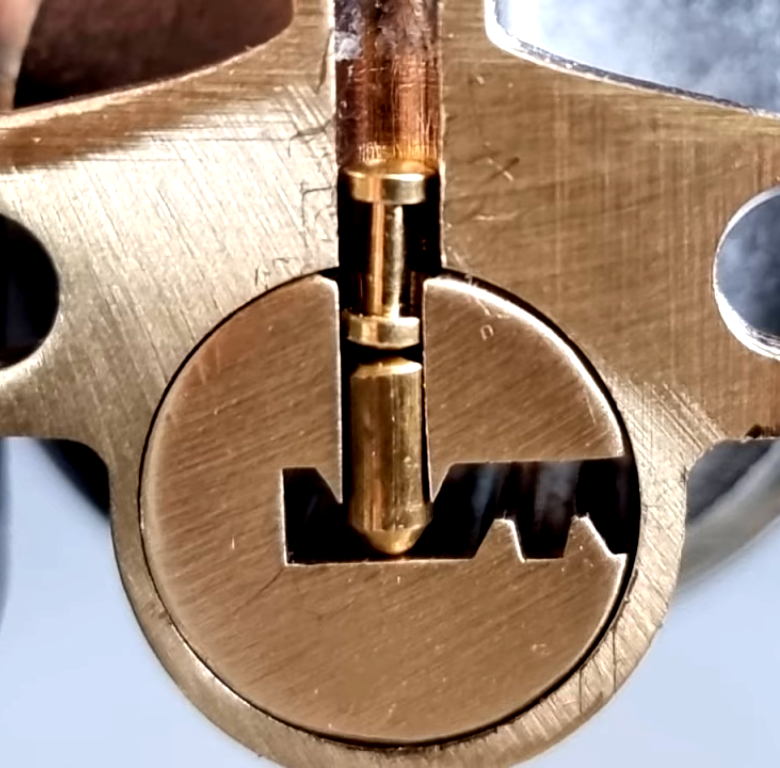
A spool pin has a thin middle section that can catch at the shear line and create a false set.
The point is not only to stop the plug from turning. A normal driver pin already does that. The point is to lie to your fingers.
Why Security Pins Work
When you pick a normal pin tumbler lock, manufacturing tolerances make one pin bind before the others. You lift that binding pin until the split between key pin and driver pin reaches the shear line. The plug turns a tiny bit, and another pin starts binding.
Security pins abuse that tiny rotation.
With a spool pin, for example, the narrow waist can slip into the shear line before the pin is actually set. The plug rotates slightly, which feels like progress, but the wider end of the spool catches against the plug and housing. The lock is now in a false set.
That false set is the classic “wait, it moved, why is it still locked?” moment.

A spool pin can let the plug rotate partially, then catch and stop the opening.
This is why raking usually starts failing when security pins appear. Raking depends on fast, loose, probabilistic movement. Security pins demand controlled lifting, controlled tension, and feedback reading.
False Sets
A false set happens when the plug rotates partway, but not far enough to open. It feels like the lock is almost there, but one or more security pins are still trapped at the shear line.
Typical signs:
- The plug turns more than usual but stops hard
- Several pins suddenly feel loose or springy
- One pin feels like it pushes the plug backwards when lifted
- The lock feels “open-ish”, but the shackle or actuator does nothing
Do not panic when this happens. A false set is not failure. It is information.
In fact, for many locks with spool pins, reaching a false set is the lock telling you: “Good, you found the security pin stage. Now deal with it properly.”
Counter-Rotation
The main technique for spool pins and similar security pins is counter-rotation.
When a spool is trapped in a false set, lifting it pushes one of its wider edges against the plug. Because of the pin shape, the plug wants to rotate slightly backwards, against the tension you are applying.
That backwards movement is counter-rotation.
The basic process:
- Apply very light tension and pick normally until you reach a false set
- Probe for the pin that gives counter-rotation
- Gently lift that pin
- Let the plug rotate backwards just enough for the pin to pass its trap
- Keep lifting until the pin sets
- Let the plug rotate forward again
The hard part is psychological: you must allow the lock to move backwards without completely dropping every pin you already set.
Too much tension blocks counter-rotation and makes the pin feel stuck. Too little tension drops the lock back to zero. The correct amount is that annoying middle ground where the plug can move, but you are still in control.
Spool Pins
Spool pins are probably the first security pins most pickers learn to recognize.
They are effective because they create very clear false sets. A lock with several spools may feel easy at first: a few pins set, the plug turns nicely, and then everything stops. From there, each spool must be lifted through counter-rotation.
How a Spool Feels
Common feedback:
- Big false set after one or more pins are lifted
- A binding pin that pushes your tension tool backwards
- A clear “drop and catch” feeling if you use too much force
- A satisfying forward snap when the pin finally sets
The forward snap is not guaranteed, but when it happens it is a great signal. The plug rotates back in the opening direction because the spool has cleared the shear line.
How to Approach Spools
Use lighter tension than you used on basic locks. If you clamp the plug too hard, the spool cannot counter-rotate and you will think the pin is impossible to move.
Then lift slowly. The goal is not to launch the pin into orbit. The goal is to let the pin shape guide the plug backwards just enough to escape the false set.
If several pins drop while you do this, your tension was probably too light or your lift was too aggressive. Reset and try again. Yes, this is normal. Yes, it is annoying.
Serrated Pins
Serrated pins are covered in small grooves. Those grooves can catch at the shear line and create several tiny fake “clicks” before the true set.
If spool pins are dramatic, serrated pins are petty.
They do not always give a big false set. Instead, they make you question every click:
- Was that the real set?
- Was that only a serration?
- Did I just overset it?
- Why does this lock hate me personally?

Serrations create multiple tiny ledges that can mimic real feedback.
How Serrated Pins Feel
Common feedback:
- Multiple small clicks on the same pin
- Short, crunchy movement instead of one clean lift
- A pin that keeps binding after one click
- Easy oversets if you lift too confidently
With serrated pins, the mistake is often stopping at the first click. Sometimes the first click is real. Sometimes it is just the pin catching on a serration. You need to keep checking whether the pin still binds.
How to Approach Serrated Pins
Use controlled tension and small lifts. After each click, stop and test the pin again.
If the pin is now springy, it may be set. If it still binds, it may need another tiny lift. If it feels completely dead and other pins stop behaving normally, you may have overset it.
This is where good pickers look boring: tiny movement, pause, test, tiny movement, pause, test.
Mushroom Pins
Mushroom pins are another anti-picking shape. They are less iconic than spools, but the idea is similar: a widened or tapered section catches at the shear line and gives misleading feedback.

Mushroom pins vary by manufacturer, but the wider profile is designed to catch.
In practice, treat mushroom pins like cousins of spool pins:
- Expect false sets
- Expect counter-rotation
- Use lighter tension
- Lift slowly and deliberately
The exact feeling depends heavily on the lock, the pin orientation, the keyway, and how worn the cylinder is.
Overset Traps and Serrated Key Pins
Driver pins get most of the attention, but key pins can also be modified. Some locks use serrated or trap-style key pins to punish oversetting.
An overset happens when you lift a key pin too high. In a normal lock, that is already bad: the key pin crosses the shear line and blocks rotation. With trap-style geometry, the lock can make that mistake even harder to recover from.

Some locks include key pin designs that punish careless lifting.
The fix is boring but important:
- Lift less
- Use a pick profile that lets you reach the target pin cleanly
- Release tension only when you need to reset
- Do not force a pin just because it is the next one in line
If a lock goes completely dead after a lift, you probably overset something. Try easing tension very slightly and listen for a pin dropping. If that does not recover it, reset and start again.
Tension Control Matters More Than Pick Choice
Better tools help, but security pins are mostly a tension lesson.
Heavy tension can be useful for finding the first binder on some locks, but once you reach security pins, too much torque becomes a problem. It locks pins in place, suppresses counter-rotation, and turns useful feedback into a vague brick wall.
Light tension lets you feel:
- Which pin is actually binding
- Whether a click was real
- Whether the plug wants to counter-rotate
- Whether a pin dropped
- Whether you are entering a false set
Think of the tension wrench as a sensor, not just a lever. Your pick touches the pins, but your tension tool tells you what the plug is doing.
A Practical Picking Flow
Here is a simple workflow for a lock that may contain security pins:
- Start with light to medium tension
- Probe all pins and find the binder
- Lift carefully until you get a click or plug movement
- Re-check the pin after every click
- When the plug falls into a false set, reduce tension slightly
- Search for the pin that causes counter-rotation
- Lift that pin slowly while allowing controlled backwards movement
- Let the plug rotate forward again when the pin sets
- Repeat until open
If you lose the set, reset and try again. That is not wasted practice. Security pins are basically a feedback training device that happens to be inside a lock.
Common Mistakes
Using Too Much Tension
This is the classic one. Heavy tension makes normal locks feel easier at first because binding is obvious. Security pins punish that habit.
If nothing counter-rotates, lighten up.
Chasing Every Click
Serrated pins can click several times. A click is not automatically a set. After each click, test the pin again.
Ignoring the Tension Tool
Counter-rotation is often clearer in the tension tool than in the pick. If your finger on the wrench feels the plug pushing backwards, pay attention.
Lifting Too Fast
Security pins reward slow lifting. Fast lifting skips feedback and turns recoverable mistakes into oversets.
Blaming the Lock Too Early
Sometimes the lock is genuinely nasty. Sometimes your tension is just too heavy. Try the boring fix first.
Practice Recommendations
Start with a lock where you know what pins are inside. Progressive practice locks, repinnable cylinders, or cutaways are useful because you can isolate one security pin at a time.
A good progression:
- Standard pins only
- One spool
- Multiple spools
- One serrated pin
- Mixed spool and serrated pins
- Real-world cylinders with unknown pinning
Do not rush to the hardest lock in your box. If you cannot explain what feedback you are feeling, make the lock simpler until you can.
Legal and Ethical Considerations
Only practice on locks you own or locks you have explicit permission to pick. Do not practice on locks that protect anything important, even if you own them. Breaking a practice padlock is annoying. Breaking your front door cylinder at midnight is a very different kind of lesson.
Check your local laws before carrying tools. Rules vary a lot by country and sometimes by region.
Conclusion
Security pins are not magic. They are small mechanical tricks that exploit your assumptions.
Spools teach counter-rotation. Serrated pins teach patience. Mushroom pins teach you not to trust every false set. Trap-style key pins teach you to stop lifting like you are trying to win an arm-wrestling match.
Once you learn to read them, security pins become less scary and more interesting. They force your picking to become cleaner, slower, and more intentional.
And honestly, the first time you intentionally ride counter-rotation through a spool and the plug snaps forward, it feels extremely good.
A slide that sums up this article:
Note: This article is for educational purposes only. Always ensure you have legal permission before picking any lock.